Saturday, November 10, 2007

London on a Thursday too!

Thursday 7th November

Surprise, surprise- the legs are still working- and well! So, seizing the day, back to London we go!

It was busier in the city today. Actually, I had an uneasy sense of the place being on edge today, especially using the Underground. There were many delays, with one line closed because of a 'police action' at Finchley Park. There were sniffer dogs, and police everywhere. The sky was dark all day (it certainly wasn't 'bright'!) and the air smelled gassy- was it brimstone perhaps???!!!

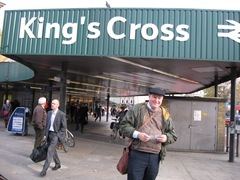
We photographed Kings Cross Station, Euston and Pentonville Rds, and had a look at St Pancras station which has been developed into the main Eurorail terminal- a huge modern new building attached to a rather florid, red-brick Victorian Gothic building.

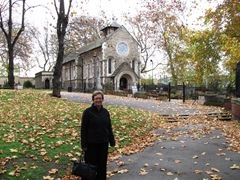
Then we walked away from all the hubbub up to St Pancras old church. What a find! I can remember drawing pictures in primary school of Norman churches with their square towers, and of course it meant absolutely nothing as no Australian child could ever see a Norman church- but here is the real thing! There has been a church presence at St Pancras since the 4th century- amazing!! The church itself is small, and very human in its scale.  It is in a park, ankle-deep in autumn leaves, and there is a large grassed graveyard surrounding the church.
IMG_0155

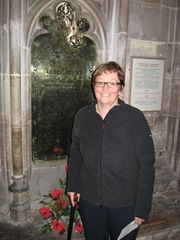
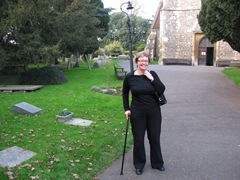
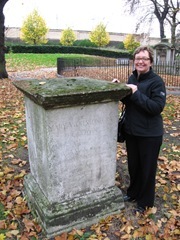
Here's Janine at the grave of Mary Wollstonecroft, who wrote "The Vindication of the Rights of Women", one of the most famous proto-feminist works.  Her daughter was Mary Shelley, who wrote "Frankenstein".  Thomas Hardy, the author, no doubt proving the adage that writing is not a lucrative career, was given the unenviable job of moving the bodies to a  new cemetery, and all the old tombstones were collected into a pile where now an old gnarled tree grows out between them- called, appropriately enough "The Hardy Tree".
IMG_0157


Then back down the hill by bus (your Travelcard allows travel on buses as well as trains- 12 pound 80 cents as long as you travel after 9.30 am. We catch the train from Maidenhead- about 45 minutes- then can use the Underground all day).  We made the pilgrimage to the British Library, but found it a bit disappointing. It's a new building not unlike the Remand Centre in Spencer Street.  It's huge but soulless and not at all enticing. It has a treasure-room of prized artefacts, and again as with the National Gallery, you realise the cultural wealth of England.  Some of the objects had been loaned to the National Gallery for that "Treasures from the Worlds Library" exhibition that we went to in Canberra few years back, and it's amazing to think that they're here all the time, just as a matter of course- a Shakespeare First Folio, a Caxton bible, the Magna Carta, the original words to the Beatles'  'Hard Days Night' or 'A Day in the Life'.

For the first time since we've been here, the rain started to fall. We've been blessed so far with the weather- blue skies most days and about 14 degrees.

The Antipodean Aunt meets Beatrix Potter Update

No progress so far on the larks, nightingale or hedgehogs.  There was an article in the newspaper about being careful that hedgehogs weren't being incinerated in one's Guy Fawkes day bonfire, but that probably doesn't count.

But I have seen deer, in the paddock outside Colin's house. Well, I think they were deer- I didn't have my glasses on, and could only detect a flash of white and some movement. But I am assured that they were deer!

And the mole hills in the paddock next door are getting closer and closer.  Not long, I think, until I see a murdered mole.

London on a Wednesday

 Wednesday 7th November

My legs having recovered their equanimity, we decided to go into London again. We saw many of the 'sights', and the day felt a bit like being in a postcard.

Our first stop was the National Gallery.  It's a beautiful building, with many small rooms, all richly appointed.  You realise the accumulated cultural wealth of a place like this when you walk into a room FULL of Reubens- not just one or two, but 25 perhaps.  The rooms are arranged chronologically, and by region- or at least the section we looked at was.  We've only just nibbled at the medieval painting and a bit of Dutch and Italian early Renaissance painting.  We'll drop by when we go past again and "do" another section- there's just too much to look at with any sense of appreciation.

Then off on the Monopoly hunt. We're making good progress.  Here's just one photo, and in theory (if I'm setting the photos up correctly) you should be able to see the other locations we've found if you click on this photo.

IMG_0147 

So far (counting Thursday which I haven't written yet) we've done 13.  Some of these places are pretty grotty- we couldn't find the Angel Islington, so we had to settle for a flower stall and newspaper stand that had "Angel Islington" signposted on the top.  They are roughly grouped together geographically, but that doesn't hold all the time- Bow Street, for example, seems to just be there on its own and its inclusion as a location seems rather arbitrary now.  I will never again put a hotel on Euston/Pentonville - it's rather grotty and you'd never cover your mortgage payments with the rentals.

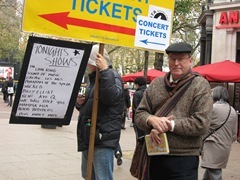
Chasing down these locations took us up into the West End. Oh Martine- you HAVE to come to London. Look at the shows that are on right now-

IMG_0130


Our last stop for the day was the church of St Martin-in-the-Fields. This location is famous for its music - I can just hear a ClassicFM announcer intoning "And that was John Eliot Gardiner and the St Martin-in-the-Fields Orchestra playing such and such". Alas, there were neither conductors, nor orchestras but there were many workmen still working on the interior- they've done a beautiful restoration-- again, very light and bright, with a white-and-gold interior.  The exterior of the church is still wrapped in plastic while they're working on it.

Actually, I've noticed that one of the terms they keep using in their weather reports is "bright"-  e.g. "it will be a bright day".  It's a consciousness that we just don't seem to have in Australia, but you can appreciate it when at about 3.45 the darkness starts to close in, or earlier in the day when it feels as if the sky is too low. and coming down to smother you.  Several of the churches we've seen- Winchester Cathedral, St Martin-in-the-Fields, the Nicholas Hawksmoor church in Spitalfields- have bright white interiors, with clear glass windows. While this no doubt reflects the style of architecture, I wonder too if this quality of brightness hasn't been ascribed to God as well, and incorporated into their church architecture.

Winchester Cathedral, you're bringing me down...

Tuesday 6th November

Our blog-posting complete, we turned our sights towards Winchester, the ancient seat of Anglo-Saxon England. As you drive into Winchester, the cathedral hunkers over the small streets like a huge grey wolf.  We got to see it from many perspectives as we went round and round and round looking for the short-term car park - there it is! Whoops! Gone too far! Round we go again!

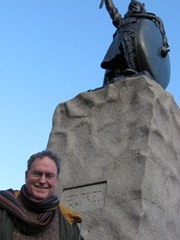
We passed a statue of King Alfred- one of Steve's heroes.  He was a fine and noble King. He burnt the cakes, but we forgive him because he gave us Wessex, and was a scholar, a soldier and a statesman. But he DID burn the cakes.

IMG_0110


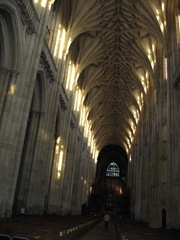
The cathedral was spectacular- very light compared with Melbourne's gothic cathedrals, with a soaring roof that could ALMOST make you believe in God. 

IMG_0114


And who should be buried there than Jane Austen!! (one of Janine's heroes). Sue Terry- if you're reading this, this one is for you.

IMG_0111 

The original cathedral on the site dated from the 10th century, but it had been replaced, shifted sideways and built onto during the 13th and 14th centuries.  I was pleased to see King Stephen and the Empress Matilda mentioned- I've read a couple of Sharon Penman books about them, even though I can't remember the details. Nonetheless, it's a bit of a thrill to see physical evidence that characters you've read about in  historical fiction actually existed.

Then, with darkness falling (at 3.45 pm), we headed for home.  What a long trip that ended up being!! We plotted out our route east along the M3, then the M25 circle road, then onto the M4 heading west.  Simple.  We made the turnoff to Maidenhead, after carefully counting down the number of exits, and then proceeded merrily  around the exit roundabout only to find ourselves in the wrong lane and  BACK ONTO the freeway we'd just left!! So we had no choice but to proceed onto Reading, where we finally escaped the clutches of  the M4 and headed back towards Maidenhead via the Roman road.  We did get home, an hour after we would have had done, we not been lured back onto the M4 by mistake.  We seem to have created a new tourism specialty- touring England by freeway by night.

Driving here is rather hairy.  The roads are VERY narrow- just the two lanes with barely a footpath. The traffic speed is slightly higher than in Melbourne (it's still in miles per hour- e.g. 70 mph on freeways which is about 116ish kmh). Once out of built-up areas that are not freeways, it is 60 mph (100) but the roads are barely one and a half lanes wide.  Of course, everything is unfamiliar to us, and it seems that the signs are not placed early enough while driving at that speed to make a decision.  There are many roundabouts, but the lanes are not as well controlled as they are in Australia, so people have to weave from lane to lane as they position themselves for their exit.  All this manoeveuring is accomplished with the windscreen wipers madly thrashing to and fro and much muttering of "Oooh, bugger, bugger"  because the indicator lever is on the left hand side of the steering wheel, rather than the right.

Tuesday, November 6, 2007

Monopoly location #1 and #2

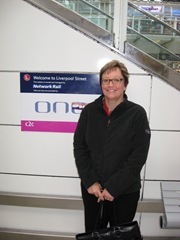
Liverpool St Station

It's a big station, with the huge semi-circular roof of the Grand Victorian stations.

IMG_0100

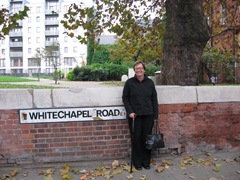
Whitechapel Rd

This is near where Jack the Ripper committed his murders. Just after Steve took this photo (which wasn't easy as he had to stand in the middle of the road, and double-decker buses kept blocking the view), a derro in the park behind me smashed a bottle against a tree to fashion a weapon that I hope he hasn't used yet.  No wonder it was cheap on the Monopoly board!!

IMG_0099

The Antipodeans venture into The Great Wen

Monday 5th November

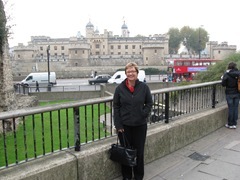
Off to the Great Wen- London.  We arrived at Paddington, then caught the Underground (with just a LITTLE bit of trepidation) to Tower Hill.  My stomach gave a little lurch of excitement as we came up from the steps and looked across at the Tower of London. What a strong statement of power it must have made!

IMG_0093

Peter Ackroyd, in his book "London" (which I wish I'd brought with me) talks about London as a palimpsest-  a layering of one thing over another, a bit like posters on a billboard.  You can peel one back, and see the preceding ones there.  It's probably true of any city, but particularly pertinent in London, where rebuilding and remodelling is constantly taking place over what was there previously.  But Ackroyd also talks about the continuity of purpose in particular places- for example, that an area known for food might have a succession of food vendors and food fashions, but still remains essentially about food.  Or a place of entertainment might have started off with outdoor plays, then be built over with a formal theatre building, then be built over yet again with a multiplex- all about entertainment, but in different manifestations.

I'm not sure if this works for the Tower though, because it seems to have two functions- as a residence for Kings, and at the same time, a place of incarceration for people who were perceived as being dangerous in some way.  The two functions don't really seem to fit together well- was the King living in a prison? Or were the prisoners being kept in a palace?  The overwhelming impression of the Tower was one of the display of power- the huge looming buildings and walls; the clanking bulk of knights in armour; the weight and sharpness of weapons; the kitsch ostentatiousness of display cabinet after display cabinet of gold; and the extravagance of crowns and sceptres that just appropriated as a matter of right the diamonds and wealth of conquered colonies.

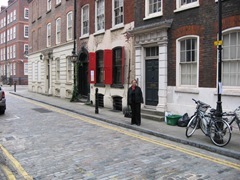
Then, off to Dennis Severs House. (See www.dennissevershouse.co.uk ) I read about this in our Time Out Guide as being one of the 10 Things To Do Before You Are a Proper Londoner. Mind you, Penny had only done 1.5 of them.  It has very restricted opening hours- the 1st and 3rd Sunday and Mondays of each month, and only for two hours.  The house was in a small street near the Spitalfields Market. It wasn't a museum as such- it was an "atmospherically restaged dwelling" and more a piece of art or theatre, than a museum. You had to knock on the door, and a man came out and explained that you had to use your imagination in the house- that you should go through it in silence, and make up your own narrative of what was going on in there.  The house itself was on five levels. The overwhelming impression was of darkness- that even though the rooms were candle-lit, and outside was light, the rooms themselves were heavy and dark.  Each room was as if the people in them had just left- the candles would gutter, there would be a half-drunk cup of tea, the chairs were pushed back.  The ground floor had two drawing rooms, then we went down the spiral stairs into an equally dark kitchen, oppressive with heat from the fire, with the smell of drop scones cooking on the stove and yet another cup of tea and half eaten child's gingerbread.  Then up to the first floor, with two bedrooms, complete with rumpled beds that looked as if they would still be warm, and two used chamberpots. On the second floor was a men's smoking room, reeking of stale wine, tobacco, dirty clothes, and men!  Then up onto the next two levels, which had been sublet as lodgings to a poor family of weavers (there were many impoverished French protestant - Hugenot- weavers in Spitalfields). As soon as you mounted the stairs, you were aware of the change- it was noticeably colder; grey sodden washing hung in the stairwell, everything was covered in the greasy cold grey of poverty.  There was a chamberpot there to, but it was foul! (I didn't venture too close!)

IMG_0097

It was thought-provoking going from the Tower of London to Dennis Severs' house.  Both, of course, are deliberate constructions.  In the Tower, it was very slick and touristy and obviously a mass market. The display pointed out that Charles II had created an exhibition called the Line of Kings in the 17th century that purported to show all the English Kings from William I onwards, even though the display was historically ridiculous (e.g. William I from 1066 was depicted with a rifle!). The Tower setting had been used by the kings themselves as a form of propaganda almost that asserted their own legitimacy as rulers and set out to "educate" the masses about the strength of the king and government.  But it felt very much like a film set, even though the setting itself WAS authentic.  Then on to Denis Severs' house that blurred the lines between imagination and display completely. It made no secret that it was Dennis Severs' own creation, and yet in many ways it felt far more 'authentic' than the Tower.

Meeting the Vicar of Bray

Sunday 4th November

It has been my intention to go to church each Sunday; not from any great spiritual yearning, but because I like to see a church in use rather than just viewing it as an object.  We called in at the Heritage Centre at Maidenhead yesterday morning and asked which was the oldest church in the area. Bray it was - "Ah! The Vicar of Bray!" announced Steve  "Why yes, the Vicar of Bray" rejoined the guide.  Who's the Vicar of Bray??? thinks Janine.  I'm still none the wiser, but I have seen him because we went to St Michael's at Bray this morning.

IMG_0073

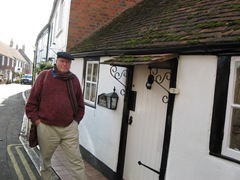
It is a beautiful Norman Church, complete with the brass figures embedded in the wall that you take brass rubbings from, and  many stained glass windows.  The church is surrounded by a graveyard, and a lych-gate leads to the cemetery.  Bray itself is a quaint little village- small cottages with doors about 5 ft in height, narrow streets, and a couple of pubs.

IMG_0077

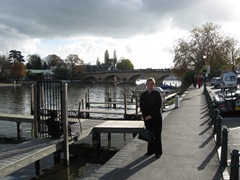
We then headed off to Henley. No regattas today- I think I prefer the "Henley on Todd" which is a boat race conducted on the dry riverbed of the Todd river in the Northern Territory.  The Thames at Henley is very broad, and ideally suited for boating.  We caught a cruise that went up and down- some spectacular houses on the banks, and many people walking along the paths and enjoying the sunshine.

IMG_0086

We've been so fortunate with the weather so far- it was about 17 degrees yesterday.  Today was a bit colder, but still sunny.  It hadn't occurred to me that, being autumn, the deciduous trees would be so spectacular.  It is very beautiful.

IMG_0090

Gunpowder, Treason and Plot

November 3rd

It was the 3rd rather than the 5th of November, but fireworks were planned all over the place.  It was intended that we would go to the fireworks at John and Tara's previous school, but then Penny learned that they were scheduled for next Saturday instead of today. So in a change of plans, we decided to go to the ones at the Ascot Racecourse.  So did many other people, and by the time that they started we were still stuck in a traffic jam, waiting to go into the carpark.  So we saved our 6 pounds each, and watched them from outside.

From our bedroom window, which looks out over the paddock, we could see a large bonfire that was burning in the adjoining field.  I looked further across, and saw a line of bonfires on the horizon. "How wonderful!" I thought, remembering being able to see bonfires right across Melbourne when I was a child.  And how evenly spaced the fires were! Wait a minute- put the glasses on- they weren't bonfires; they were the lights on the M4 motorway!!

Nonetheless, there WERE a number of REAL bonfires that we could see from the window, with rockets shooting up into the sky.  The whole Guy Fawkes thing has an added resonance since September 11.