Sunday 25th November
Yet another early start, this time to catch the 6.30 a.m. train from Maidenhead in order to be there for our 9.15 journey to Paris. The two trains didn't connect well, and after the many hold-ups on the Underground yesterday, we weren't game to cut our time too finely. At least it was positively balmy compared to the day before (in fact, when we were coming home from Colin's party the night before at about 11.45 it was a couple of degrees warmer than it had been all day. It seems odd for the temperature to rise at night.)
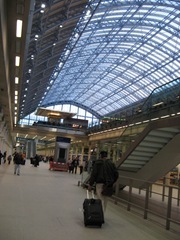
The Eurostar now departs from St Pancras Station- a highly ornate, mock-Gothic station which very nearly was demolished. The Poet Laureate Sir John Betjeman campaigned vociferously for it to be retained, and many people now praise his foresight because it truly is a wonderful station. I don't know what it looked like before, but it's pretty spectacular now.
The trip took just over two hours. It all runs on a stripped-down airport model. The security is similar with Xrays of all luggage and passport control. But once you're through all that, you just sit around until you are called, put your ticket through the turnstyle and then find your own seat. There are no stewards or hostesses, and you wander yourself up to the buffet car if you want something to eat. There were many empty seats, so we were able to move from our seat beside a pillar which blocked our view into one with a window view. And in the event, we found that we were sitting in the wrong seats anyway! - we should have been in the next carriage!! The train moved fast, but not so fast that you couldn't see. It was in the Channel tunnel (under the sea) for about 15 minutes.
At first when we broke into daylight again, I thought that the land looked pretty much the same as the English countryside that we had left. But then I noticed that there were no fences or hedges at all. One part of a field would be ploughed earth, then all of a sudden, as if the farmer thought "Hey, I think I'll sow something now", there would be a field of green grain. It all seemed rather arbitrary. There were little villages, as in England, centred around a small church but the towers were like the light grey square Norman towers of England but with a tall conical 'hat' on them.
And it was so very, very flat. We passed a couple of war cemeteries- one was an Imperial War Graves Commission cemetery with all the small white grave-stones standing in very straight rows. The other had wooden crosses and a large French flag flying in the centre, so I assume that it was a French cemetery. I now understand why the World War I battlefields revolved around such seemingly insignificant physical features- a slight ridge here, a small village there, because they just stretched on, almost featureless, for miles.
Coming into Paris itself, I was struck by the amount of graffiti. I know that railways attract it- in fact, travelling around on the Metro underground railway, there's even graffiti the whole length of the tunnels between stations which would be a risky undertaking, I should think. But in many places there's graffiti- far more than you'd see in London or even in Melbourne. Nothing very witty- just the usual tagging.
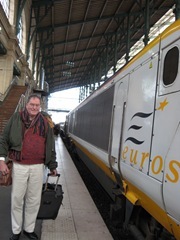
The train itself is quiet and very, very, very long. In fact, walking along it you wonder if you're ever going to come to the end of it!